
Introduction
Farm Minerals is an AgriTech company developing emissions-free fertilizers and feed additives designed to improve how nutrients reach plants. Their technology delivers nutrients directly into plant cells, reducing waste while eliminating carbon emissions at the source.
For Farm Minerals, Adelt design studio designed and developed a modern website that communicates complex agricultural technology through a clear visual system and interactive product storytelling.
Our task at Adelt was to translate a highly technical, science-driven product into a digital experience that feels clear, credible, and grounded in real agricultural practice. The challenge was not only to explain how the technology works, but to communicate it in a way that feels practical and trustworthy for people who work in agriculture every day.
The audience includes farmers, researchers, agronomists, and industry partners — people who rely on measurable results, field performance, and real data rather than marketing promises. Because of this, the website designed and developed by Adelt needed to communicate a new technology without sounding speculative, overly futuristic, or disconnected from real farming conditions.
Rather than presenting the product as another sustainability narrative, the goal was to show something far more practical: a better and more efficient way fertilizers actually work in the field.
The problem we had to communicate
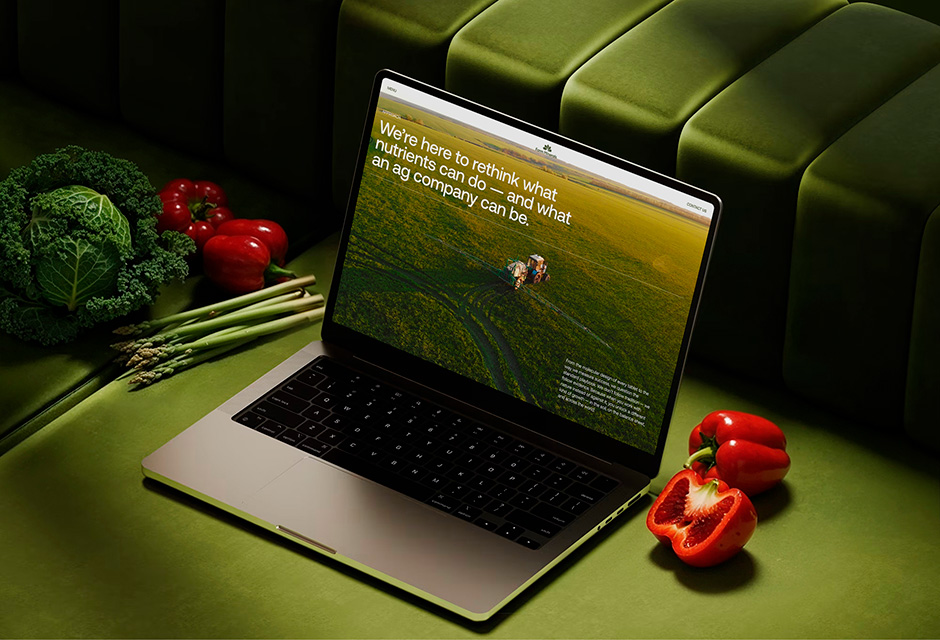
Modern agriculture relies heavily on fertilizers that are surprisingly inefficient. A significant portion of nutrients applied in the field never actually reaches the crops.
In fact, up to 70% of nitrogen used in agriculture is lost before plants can absorb it. It evaporates into the atmosphere, washes away with rain, or becomes locked in the soil. Farmers often compensate for this inefficiency by applying higher volumes of fertilizer, increasing the number of treatments, and facing steadily rising operational costs.
At the same time, many sustainability-driven solutions in agriculture are difficult to communicate clearly. They often appear abstract or overly technical, making it hard for farmers to immediately understand the practical value they bring to everyday agricultural work.
For Farm Minerals, the challenge was therefore twofold. First, the Adelt team needed to translate a completely new fertilizer technology into a clear digital experience, explaining how it works without making it feel overly complex or disconnected from real farming practice. Second, the website designed and developed by Adelt had to help rebuild trust in how fertilizers can work by demonstrating measurable efficiency rather than simply promising environmental benefits.
The digital experience also needed to communicate that this innovation is not theoretical. It had to feel precise, measurable, and practical, while still appearing modern and forward looking. This balance was important because both the technology and its founder represent a new generation in agriculture.
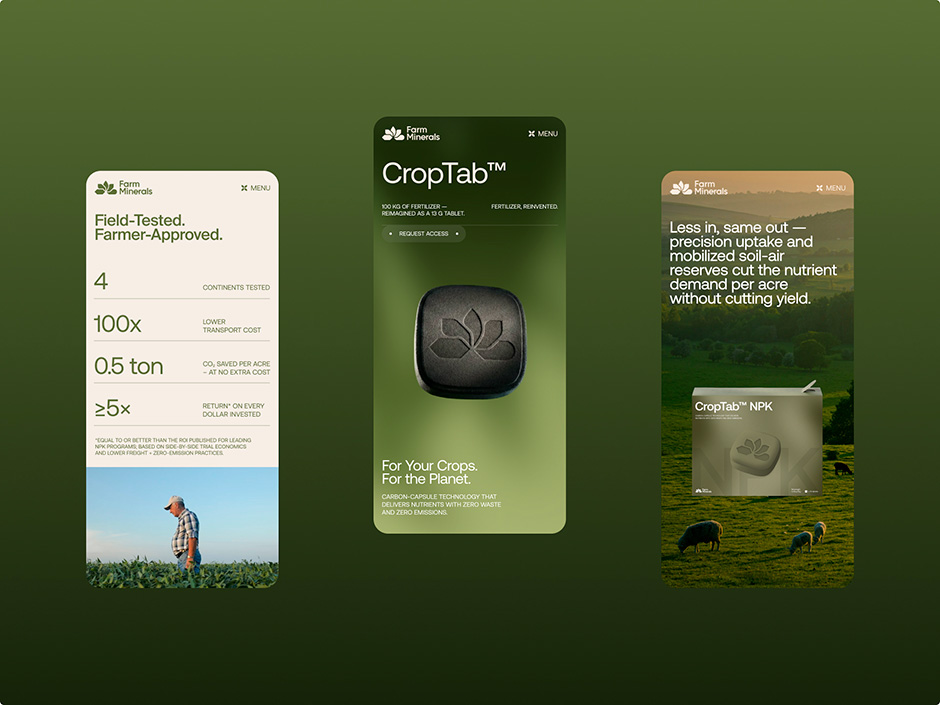
Rather than overwhelming visitors with technical explanations from the start, the Adelt team structured the website narrative progressively.
The story unfolds through four clear stages: Problem → Explanation → Evidence → Application. This sequence allows visitors to first understand the challenge modern agriculture faces, then learn how the technology works, see proof of its effectiveness, and finally understand how it applies in real farming practice.
This narrative structure helped transform complex scientific information into a clear and digestible story. Instead of presenting large amounts of technical detail at once, the interface gradually introduces new layers of information as the user moves through the page.
As a result, the experience remains calm and readable while still communicating the depth of the technology. The design guides visitors step by step, helping them understand not only what the product is, but why it matters and how it works in practice.
Design decisions were closely tied to this narrative structure. A clear visual hierarchy, generous spacing, and large typography help guide visitors through the content without overwhelming them with information. Each section focuses on one idea, allowing the technology to unfold gradually as the user scrolls through the page.
Motion was used carefully to support the story. Subtle animations and transitions help illustrate the product and its effects while keeping the interface controlled and easy to navigate.
“You can introduce complex science — as long as the story stays grounded in reality and the visuals and animations help translate it.”
Lessons Learned
Every project teaches something new. Farm Minerals became a particularly interesting experience for the Adelt team because it sat at the intersection of science, agriculture, and digital storytelling.
Several important lessons emerged during the process:
Designing websites for scientific and technical products requires a deep understanding of the product itself. Surface-level explanations are rarely enough. Close collaboration between Adelt and the Farm Minerals team helped us understand how the technology actually works and how it should be communicated to different audiences.
Another key insight was the importance of narrative structure. Products built on science often come with the instinct to explain everything at once. In practice, a more effective approach is to reveal information gradually. Structuring the story step by step allowed the technology to remain understandable without oversimplifying it.
Credibility also became a central design principle. In conservative industries such as agriculture, trust matters more than visual spectacle. For the website designed by Adelt, restrained motion, clear typography, and structured layouts helped position the product as precise and reliable rather than experimental.
Finally, the website itself became part of the product experience. For many visitors, it is the primary way to understand how the technology works and why it matters demonstrating how thoughtful digital design can help complex innovations become accessible and understandable.
Product Visualization
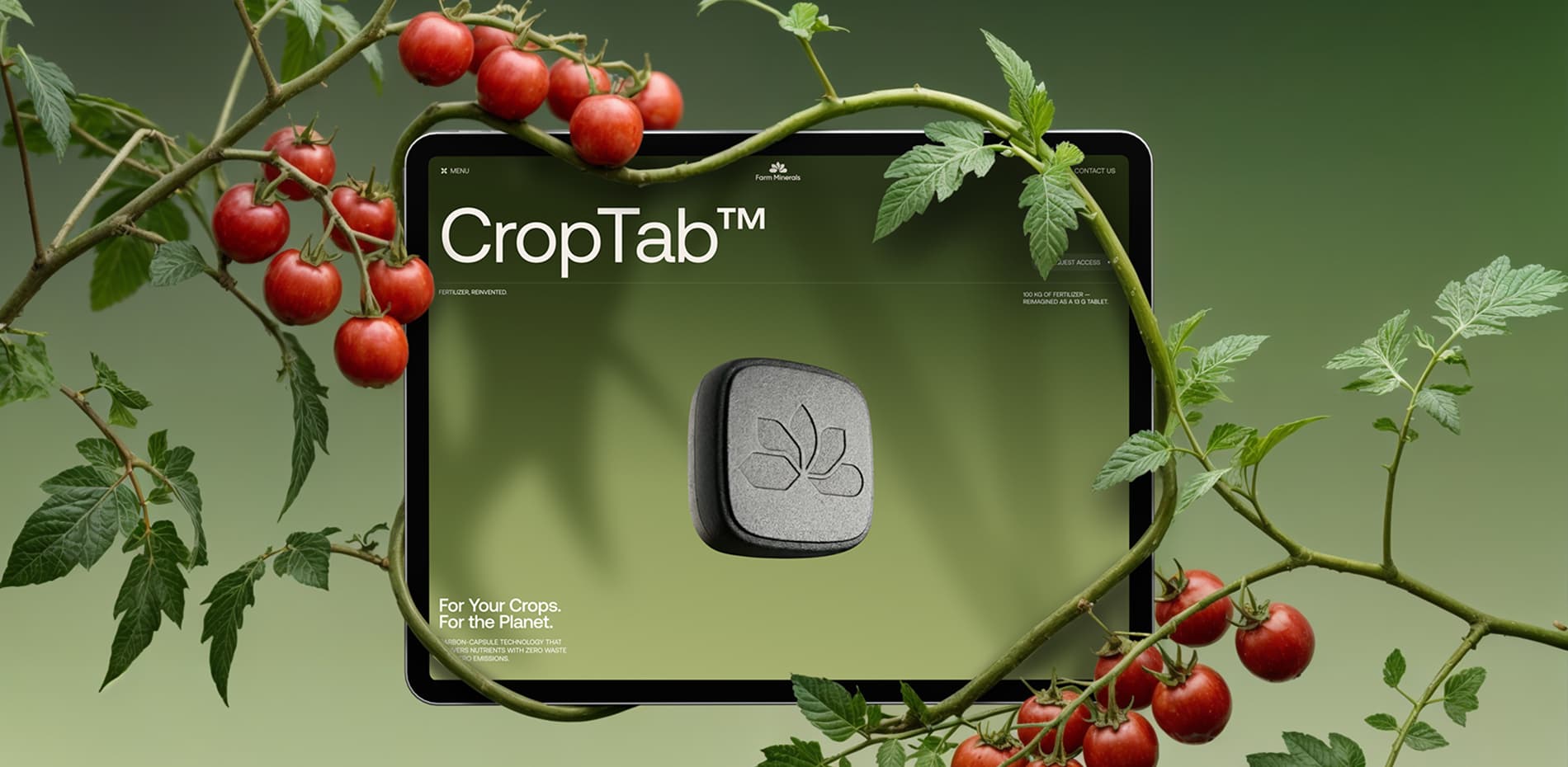
One of the key challenges of the project for the Adelt team was visualizing a technology that operates at a microscopic level inside plant cells. Communicating this process directly would have required complex scientific diagrams, which could easily make the interface feel too technical.Instead, the visual storytelling focuses on the CropTab tablet itself. The product becomes the central visual element of the website designed by Adelt, appearing in multiple contexts across the page. Close-up product shots, environmental scenes, and subtle motion help connect the technology to real agricultural practice.
This approach keeps the experience grounded and tangible. Rather than abstract representations of science, visitors see a clear and understandable product interacting with real crops and environments.
Across the website, these visuals play a key role in explaining the product. Instead of relying on abstract scientific diagrams, Adelt’s design approach focuses on a tangible object that visitors can immediately understand. This approach helps bridge the gap between complex plant biology and everyday farming practice, allowing the technology to feel both innovative and practical at the same time.
Technologies
Frontend Frameworks and Libraries
The website was developed in Webflow, allowing us to combine precise design control with a scalable CMS structure.
Animations and panel transitions were implemented using GSAP, which enabled smooth storytelling interactions while keeping performance high.
Backend Technologies
The project relies on Webflow’s native CMS architecture to manage product data, scientific content, and informational pages.
Server Architecture
Webflow’s hosting infrastructure provides global CDN delivery, ensuring stable performance for large visual assets and animations.
Tools
Key tools used during the project:
- Figma — interface design, layout system, and prototyping
- Webflow — website development and CMS structure
- GSAP — animation framework for transitions and interactions
AI-Assisted Production Tools:
- Veo 3 — generation of the 360° rotating product video
- Kling — animation of the tablet dissolving sequence
- Nano Banana — AI-assisted visual generation for product scenes and compositions
- Kive.ai — creation of contextual product mockups and environment visuals
- Adobe Photoshop — compositing, retouching, and final image refinement
Company Info
Adelt is a design studio focused on brand identity and digital products. We help innovative companies turn complex ideas into clear and elegant digital experiences. Our approach combines strategy, design, and modern web technologies to create work that is visually refined, fast to deliver, and practical for real business growth.