
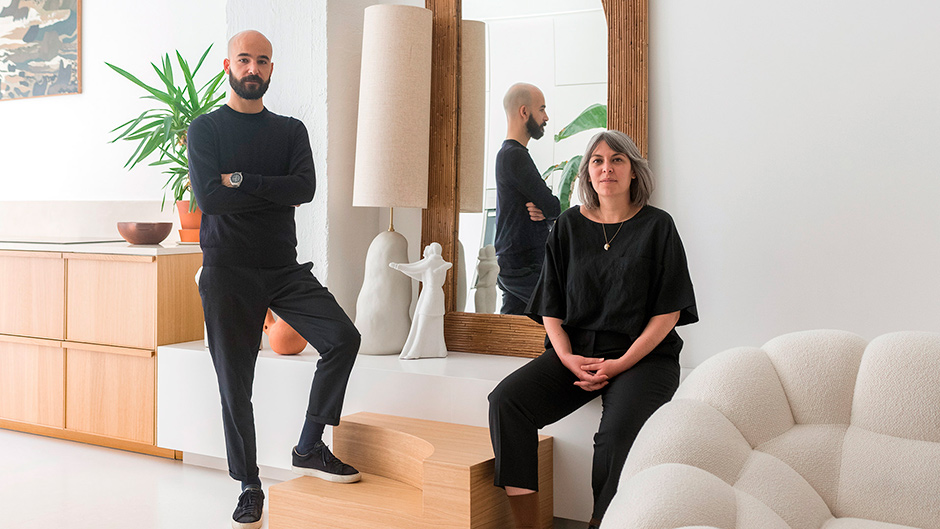
Emmanuel Cruellas — Co-founder & Creative Director, Bonhomme
Founded in 2013 by Emmanuel Cruellas and Morgane Urbain, Bonhomme is an independent creative studio specialising in branding, content creation and digital experiences for luxury and premium brands. Both trained as designers, they have developed an approach that bridges brand strategy, visual identity and digital design, helping companies create coherent and memorable experiences across every touchpoint. Over the years, Bonhomme’s work has been recognised with more than 200 international awards, including numerous distinctions from Awwwards. As he celebrates 20 years in the creative industry, Emmanuel reflects on the evolution of branding, digital design and the role creativity continues to play in shaping memorable brand experiences.
How would you define your creative philosophy?
It's all about branding. We try to start with our client's brand DNA. What makes them unique? How do they stand out from their competitors? Once the starting point is defined, our minds naturally run through all the references we've seen, whether in the client's sector or another. We're not really interested in the codes used by competitors; the idea is rather to try to make the client stand out from the market. We strive to find a graphic starting point that allows us to easily implement a system, a logic that creates consistency across all communication media.
We try at all costs not to be influenced by graphic trends that could quickly render a visual identity obsolete. The idea is to create a deliverable that will last over time.
How does your creative process work on a daily basis? (brief → brainstorming → execution)
Morgane (my partner) and I try to take charge of project design to allow the teams to focus on production. We take the brief and study it together before developing a joint response.
First, we begin with an immersion phase in the brand's universe, including an analysis of existing communication materials, user experience workshops, and ideally, strategic interviews. Then, with the team, we develop two to three graphic approaches to help the client visualize the brand and choose a positioning that is both aesthetically pleasing and strategic. These approaches are based on key elements that emerge from the brand platform analysis. Finally, once the client has communicated what resonates with them in the proposals we present, we move into the production phase of the final deliverables.
How do you work with teams (designers, editors, strategists, clients) to bring out the best ideas?
Morgane and I manage every project at the studio. From client relations to creative direction, we are a point of reference for our clients and a bulwark for our teams. We ensure that our art directors are solely focused on their role as designers.
Since the advent of generative and conversational AI, their role has evolved considerably. We challenge them less on the graphic dimension, which can be mastered by AI, and more on their ability to demonstrate creativity and build upon an idea. The importance of graphic and design culture in general is now paramount. The goal is no longer to create beauty, but to create relevance with subtlety.
We now encourage our designers to develop their artistic skills and mastery of drawing so that they can bring genuine artistic value to their work, even if it is generated by AI.
Which project completed at Bonhomme makes you most proud, and why?
Among the projects we are most proud of, the TAG Heuer campaigns stand out: Eyewear, Super Mario, Skipper, and Kith. Each of these is a landing page built around strong storytelling, highly immersive digital experiences, and very effective conversion performance.
For the Eyewear collection, we designed a real-time 3D immersive landing page where products rotate and reveal themselves progressively through the scroll, combining animated typographies, mask effects, and visual transitions — reaching 100% visibility on the primary call-to-action and a 74% attraction rate on the iconic references carousel.
For Super Mario, the challenge was to make two iconic worlds dialogue — Swiss watchmaking and the playful universe of Nintendo — while driving real commercial results: the 3,500 limited edition watches sold out in under twenty minutes after launch.
For the Carrera Skipper, we built a progressive narrative experience in real-time 3D, where a sailing boat modeled in 3D evolves at the rhythm of the scroll, immersing the user in the heritage of the America’s Cup.
And for TAG Heuer x Kith, we reactivated the energy of 1990s Formula 1 through a contemporary immersive experience, combining retro-inspired typographies and masks with dynamic scroll mechanics.
What these four projects have in common is the trust TAG Heuer places in us. The client always gives us complete freedom to propose the concepts and experiences that best express the campaign. It’s when you have carte blanche that you feel the most pressure — because you want both to meet the client’s expectations and to create projects that live up to your own ambitions. It’s too rare an opportunity to take lightly.
What trends in creation (design, digital, storytelling) excite you the most today?
I like this return to a more typographic and functional approach. We feel a real return to the international style that is combined with technological advances and motion design trends that make the projects very attractive.
What skills or qualities do you think are essential for this job?
You absolutely must be curious to cultivate your eye and sharpen your expertise.
We are entering an era where technical skills will become obsolete. Thanks to AI, it is no longer essential to have complete mastery of motion design, 3D, or graphic design software. However, it is becoming crucial, in order for our work to stand out from the sea of AI-generated images, that our production captures attention through its relevance and sophistication.
How do you manage to reconcile creativity and the business/strategic constraints of clients?
Creativity has no constraints; only thoughts are limiting. Regardless of the business or strategic context, being creative means successfully translating an idea and finding the right way to achieve it.